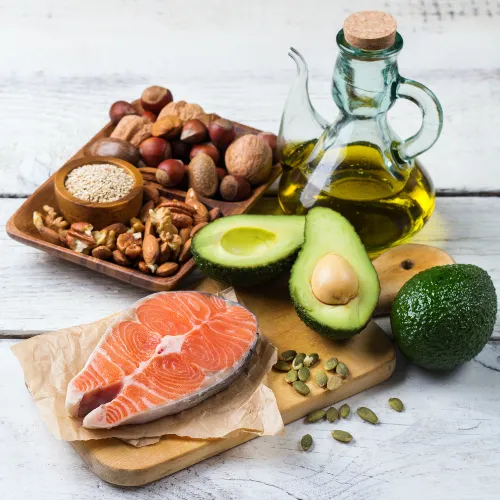
Saturated, Monounsaturated, and Polyunsaturated Fats
Deep dive
Fats are commonly grouped by chemical structure, food source, and how they appear in oils and everyday eating patterns. Saturated, monounsaturated, and polyunsaturated fats are the three major categories used in most nutrition discussions.
Within the broader category of fatty acids and lipid-based supplements, saturated, monounsaturated, and polyunsaturated fats are best understood as organizing categories. They help explain how fats appear in foods, oils, supplements, and everyday nutrition patterns.
Why fats are grouped into categories
Fats differ in chemical structure. These structural differences influence how fats behave in foods and oils, including whether they are more likely to be solid or liquid at room temperature.
Nutrition discussions use these categories to make it easier to describe fats. Saturated, monounsaturated, and polyunsaturated are not separate food groups. They are ways of describing different fatty acid structures found in foods and oils.
What saturated fats are
Saturated fats contain no double bonds between carbon atoms in their fatty acid structure.
They are commonly found in foods such as butter, cheese, cream, fatty cuts of meat, coconut oil, and palm oil. Because of their structure, saturated fats are often solid or semi-solid at room temperature.
In everyday nutrition discussions, saturated fats are often associated with animal-derived foods and certain tropical oils. However, most foods contain mixtures of different fat types rather than one isolated category.
What monounsaturated fats are
Monounsaturated fats contain one double bond within their fatty acid structure.
They are commonly found in foods such as olive oil, avocados, nuts, and certain seeds. These fats are often liquid at room temperature and are closely associated with olive-based cooking traditions and plant-centered eating patterns.
Monounsaturated fats are usually discussed within broader conversations about food quality, cooking oils, and long-term dietary balance.
What polyunsaturated fats are
Polyunsaturated fats contain multiple double bonds within their fatty acid structure.
This category includes omega-3 and omega-6 fatty acids, which are among the most commonly discussed fats in nutrition and supplement conversations.
Polyunsaturated fats are found in foods such as fatty fish, seeds, nuts, algae oils, and many plant oils. Because omega fatty acids belong to this category, polyunsaturated fats often receive more attention in supplement-related discussions.
For more on how omega fatty acids are commonly categorized, see Omega-3, Omega-6, and Omega-9 Fatty Acids Explained.
Why foods usually contain mixtures of fats
Although fats are grouped into categories, most foods and oils naturally contain a mixture of saturated, monounsaturated, and polyunsaturated fats.
Olive oil is commonly associated with monounsaturated fat, but it also contains smaller amounts of saturated and polyunsaturated fats. Nuts, seeds, fish, dairy products, meats, and plant oils also contain more than one type of fat.
This is why fat discussions are often more useful when they focus on overall eating patterns instead of treating each fat category as completely separate.
How fat categories appear in supplements
Fat-based supplements are often grouped by oil source or fatty acid composition. Fish oil, algae oil, flaxseed oil, krill oil, and mixed fatty acid products are common examples.
Polyunsaturated fats, especially omega-3 fatty acids, are among the most common fats encountered in supplement form.
At the same time, lipid-based supplements are best understood as concentrated sources of fatty acids rather than separate nutritional systems.
For more on how marine oils are commonly interpreted, see Understanding Fish Oil and Marine-Based Supplements.
How fat terminology can become confusing
Fat terminology can feel confusing because fats are categorized in several overlapping ways. A food may be described by fat structure, oil source, omega content, processing method, or role within a dietary pattern.
Popular phrases such as "healthy fats," "good fats," and "bad fats" can also oversimplify the topic. These phrases may be easy to remember, but they often blur the differences between structure, food source, amount, and overall dietary context.
At a foundational level, saturated, monounsaturated, and polyunsaturated fats are structural categories. They help organize how fats are discussed, but they do not fully describe the value of an entire food or diet pattern.
How fats fit into everyday eating patterns
Fats are usually consumed through broader food patterns rather than as isolated nutrients. Cooking oils, nuts, seeds, dairy products, fish, spreads, processed foods, and meal-preparation habits all influence how different fats are used in daily routines.
Many commonly used oils are associated with one dominant fat category, even though they contain mixtures of several fat types. Olive oil is often associated with monounsaturated fat, fish oil with omega-3 polyunsaturated fat, and coconut oil or butter with saturated fat.
For more on how oils are interpreted across foods and supplements, see Food Oils vs Supplement Oils.
Bringing it together
Saturated, monounsaturated, and polyunsaturated fats are categories used to organize how fats are discussed within foods, oils, nutrition, and supplements.
These categories reflect structural differences between fatty acids, but most foods naturally contain mixtures of several fat types. For that reason, fats are usually best understood in the context of broader eating patterns, food sources, and long-term dietary structure.
Understanding these distinctions helps clarify how fatty acids, oils, food patterns, and lipid-based supplements fit together within everyday nutrition.

 Session Expired from Inactivity